Showing posts with label Kansas. Show all posts

Wednesday, March 02, 2016

Under the Influence


 Once Jesus was asked by the Pharisees when the kingdom of God was coming, and he answered, ‘The kingdom of God is not coming with things that can be observed; nor will they say, “Look, here it is!” or “There it is!” For, in fact, the kingdom of God is among you.’--Luke 17:20-21


            It’s been five years ago that I sat on the steps in Miller Church and gave a sermon. A tornado had ripped through the town just south of them, the night before. Under the darkness of night, when it happened, it was only partly obvious what destruction had taken place. It was only in the light of a new day that it would become apparent, all the damage that had been done. I wanted, somehow, to comfort them, but also to impress upon them that something major had happened. Soon, they would drive over and see what had happened. It was probably going to be a shock to them. And it was going to take awhile before things got back to normal.
            Today feels a lot like that day. Only there are a few more miles in between us and Hesston, and Newton, for that matter. We have had a day or two to let the shock sink in. But tragedy has come near, and it is unsettling.
            Amazingly enough, it does fit quite well with the scripture for today. Jesus talks about the Kingdom of God. How it is among us, within us. The Kingdom of God came near when Jesus came to earth, a little baby boy, grew up, became a man, worked and served among us. He brought the Kingdom of God near. And when he left, ascended to heaven, he and the Father sent the Holy Spirit to keep being here, with us. Something miraculous happens, when the Holy Spirit becomes a part of us. We take the Kingdom of God and we spread it around. It grows like the mustard seed. It leavens the flour, like yeast.
We get the Kingdom of God inside of us to take out into the world, several ways. We come here, and we hear the scripture proclaimed. Hopefully it doesn’t just bounce off our minds and hearts. Hopefully it goes inside, and stays there. We receive Communion, and the blessed elements of bread and juice physically go inside us. We pray, and the Holy Spirit rises within us. We sing the music that teaches and reminds us of the awesome power and love of our God, and it goes inside our hearts.
            We go home, and hopefully we continue to receive the things of God—things that lift our hearts and encourage us, give us strength. We continue to read the Word, to pray, to listen to music that glorifies God. The Kingdom of God is within us. And we carry that out into the world, and we share it with others in how we love, in how we conduct ourselves, what we say to people… and we become the yeast that leavens the flour and makes it rise. We become the one little mustard seed that ends up growing branches for others to rest in.
But you see, we’ve got to be intentional about placing the Kingdom of God there, inside us, in the first place. You eat peas and carrots, and you’re going to be full of them. You drink pop, and you’re going to be filled with that. Whatever you ingest on a regular basis—whatever crosses the path to your heart and your brain—this is the Kingdom that is within you.
            You could say that whatever you ingest on a regular basis—spiritually, mentally, emotionally, even physically--becomes what you are under the influence of. So the question today is, “What are you under the influence of?” Whatever we regularly feed our hearts and minds can cause us to do things, say things, act in certain ways. 
When they went to the trailer home of the man who decided to go up the highway from Newton to Hesston with a couple of guns this week, they found a few things lying around, that we can guess he was under the influence of, at the time: An empty bottle of liquor. The case for a Special Ops video game, which probably meant he was, in his mind, visually going through rooms or places with guns, and mowing down people indiscriminately, before he actually went out and did that. We also know there was loud music playing, when law enforcement got to the site. I’m going to guess it wasn’t the kind of music that makes you feel soft-hearted and tender. I’m going to guess it had some rather aggressive music and words. I don’t know. I could be wrong. But I know that, at times, I’ve been under the influence of music that made my mind, my mood, go places that weren’t positive and helpful. Music is a powerful, powerful thing. It can be like a mind-altering drug.
            I’ve heard from a number of people that video games don’t cause folks to go out and shoot people. But when you look at what this man was under the influence of—alcohol, violence, aggression anger-- coupled with the trigger of new legal problems, it appears that everything worked together quite negatively, like a toxic cocktail, and provided the fuel for him to drive back to work and do the unthinkable.
Whatever you are under the influence of, will determine your attitude, your mood, even your actions. It will determine how you see things that happen to you, affect your whole perspective on life.  Is it good? Is it bad? Will it get any better??
Jesus says the Kingdom of God is not of this world. That is why we have to receive it, and take it OUT into the world.
            On the other hand… on the other hand, what were some of the people under the influence of, who were victims? Did you see some of the video that was taken, on Friday? A young man shot four times, twice in the chest, who said it was a God thing that he was still alive. One of those bullets could have easily hit his heart. Instead of anger for the man who shot him, he had sadness. It broke his heart, he said, to think that this was the only thing that the shooter thought he could do to make things better. Instead of his heart being pierced by his attacker, it was broken. It’s easy to see how the Kingdom of God was within this young man, who was shot. "God should be in the spotlight."
            Time and time again, I listened to interviews of the people who had been injured. They all attributed their survival to divine intervention. The grace of God. Nothing short of a miracle. And so for the whole world to see--because it did make national, even international news--the Kingdom of God was near, there in Hesston, in the hearts and minds of those who pointed to their God as the reason for their survival. True, a few did not make it. But it could’ve been so many more.
            So it all comes down to this, on this day: we’ve got to decide what we’re going to be under the influence of. We have a choice, what we put into our bodies, our hearts, our minds. We have a choice, what we will live under the influence of. And what we will take out, into the world, to give to others.


Monday, October 27, 2014

George Ablah: High risk, high reward

I received word this evening that George Ablah of Wichita had died. Years ago, when I was an editor for the Wichita Register magazine, I interviewed him; in a strange turn of events, the feature never ran.  If it were to appear in print, I would take more time to do some fine editing/rewriting. However, as it stands, I think the details about this gentleman's fascinating life are worth sharing and preserving. Thanks go to George's son, Jeff, for filling in many of the details.--KB


George Ablah

High risks, big reward


With George Ablah, what you see is what you get. The owner of Ablah Enterprises, he’s a freewheeler who can’t stand restraints. He typically won’t wear a suit and tie. And at a time when most people of his business stature won’t leave home without their Blackberries, he remains attached to a singular piece of paper. Ablah carries one around in his pocket, updating it constantly and filling both sides with everything he needs at his fingertips, highlighting what’s most important in several bright colors. 

At 16, he owned a gas station and a liquor store, and had traveled back and forth to Chicago to make real estate transactions. He did a stint at KU and WSU, but all the business acumen he would need was either already in his gut, or would be learned by trial and error. Along the way he learned perseverance, the importance of continuing, despite the odds. Ablah nearly died at 20 while working on a construction crew. A house jack he was manning snapped and hit him in the head. As a result, he lost the hearing in one ear. It affected his vision. But he’s never let either inconvenience stand in his way.

      The eldest son, he left his father’s business, Ablah Hotel & Supply, to strike out on his own. The company made everything from coffee mugs to dinner tables to restaurant floor plans. George worked until 2 and 3 a.m., drawing up designs. For a time, he and his wife lived with their young family in a College Hill duplex shared by his father and uncle’s families.
      With his wife, Virginia, working at his side for often six days a week, Ablah built a real estate and oil investment business that spans almost fifty years and every major city in the United States. There’s probably no metropolitan area in America that Ablah hasn’t considered a piece of property in. At 78, he’s got no plans of slowing down. Currently, he’s doing business in Memphis, North Carolina, Texas and Arkansas.
      By all newspaper accounts, Ablah seems to swoop in, quickly assess a property, snatch it up and swoop back out again, confidently decisive, holding onto the land or buildings only long enough to turn a profit. He is a true entrepreneur, a risk taker and a gambler. When others would balk at property based on the fact it’s one hundred percent vacant, Ablah sees clear potential, and buys it without a second thought.
      And his interests are diverse. Aside from oil and real estate, he’s had his hands in medical supply, steel, health care, computer software, restaurants and more. He goes to Las Vegas once a month, whether he needs it or not. And in his typically larger-than-life fashion, he’s managed to win $1 million at the table in one sitting.
      Time is one’s most valued commodity, he tells his grown children and those fortunate enough to hear his twelve steps for business and life. One way he saves time is through an uncanny ability of quickly scanning information to determine if a piece of property is worth pursuing.
      It was thirty years ago that Ablah bought Chrysler Realty with Charles Koch, dba ABKO. Ablah, realizing it would take him a year to visit two of the six hundred car dealerships each day, didn’t wait on his personal surveys or the written ones before he signed on the dotted line. Time was of the essence. Doing business as usual with a gentleman’s agreement, he took the word of the sellers that everything regarding the multi-million dollar holding was as it should be.
      Personally involved in more than $2 billion in real estate transactions, Ablah has never been in a lawsuit, a testimony to his personal ethics. While others burn bridges behind them, he knows he can look at himself in the mirror each morning. He also knows he can go back to the same people, over and over, and they’ll be happy to do business with him again. Perhaps another reason for this is that he tries to see things from the other side. Quite literally, he reads contracts from both sides of the table to make sure they’re fair, rising from his chair to sit on the other side of the table to look things over to see if he’d be comfortable doing business with himself.
      Locally, Ablah owned much of the land from Rock Road north of 29th Street. He built Northrock Theatres and the bowling alley, Jimmie’s Diner, and the five-story building at 29th and Rock where Wendy’s sits. “He built that on spec,” his son, Jeff, says of the latter in amazement. “At the time, there was nothing there. I remember, because I was out hunting in the field across from it, where Walmart is, now.”
      Ablah donated land to the city for the K-96 Expressway with the stipulation that construction begin in 1992. Thus, commuters on the north end of Wichita have been able to fly to their workplaces every day for years, while those who work farther south still await the Kellogg flyover completion.
      Time is of the essence. Ablah starts his workday at 5 a.m. And every morning at 11:25, like clockwork he walks down his office hallway and offers to buy lunch for anyone who will join him at his big heart-shaped desk, and chat. He knows all about relationships. The loyal friendships he’s made throughout his life have helped carry him through any rough patches. Because even the best gambler runs out of luck sometimes. 
      And the true measure of any person in any setting is how they perform when things aren’t going their way. “When most would fold up their tent and say, ‘I’m done,’ he kept going,” says son Jeff, who works in the family business in investments. (Ablah has another son who also works at Ablah Enterprises and focuses on oil.)
      Each time, Ablah has come back, successful once again. Jeff remembers the day his dad “lost a huge deal, and went on with his normal day. ‘Don’t you want to go play some golf, or go home awhile?’ he asked his dad. But Ablah doesn’t waste time thinking about things he can’t change. Do that, he told his son, and “you lose that moment forever.”
      A bleu cheese dressing fan, when Ablah sampled a particularly tasty batch in Colorado, he immediately asked the restaurant owner for the recipe. He was led out to a barn, and was shown the large wooden bucket where it was made. Ablah wanted the recipe for himself, so he bought it and formed a company called Swiss Chalet. Even now, the mini croutons sold in grocery stores as Crispins, are the remaining signs of his salad days. When he sold Swiss Chalet, he briefly became the largest individual shareholder of the Clorox Company.
      There came a point in Ablah’s life when he sometimes flew to three different cities in one day before arriving back home in Wichita. And so, he became partners with Jack DeBoer, and bought out DeBoer Aviation. Then he made his pilot, Ron Ryan, a full partner, and formed Ryan Aviation. The pair later sold it to a public company called PHH before Ryan bought it back again.
      Along the way, he also became a golf course developer. Willowbend was to become the first for him, but so far, it’s his one and only. He simply wanted to prove one needn’t be a millionaire to enjoy the perpetually green scenery and spend time out on the fairways.
      Equal access is a theme that runs through another project, this one on a tremendously creative scale. When Ablah became the largest owner of Henry Moore sculptures in the world, he offered to loan several pieces to New York City. People who typically didn’t see the inside of an art gallery ought to see the inspiring works of one of the world’s most renowned artists, he thought. So he wanted to place the sculptures outdoors, in the city’s parks and boroughs.
      Fearing the priceless work would become victim to graffiti and vandalism, Mayor Ed Koch wanted to wall off the artwork with guards and fences. But Ablah said no, and took personal responsibility for the art himself. As if some divine force were protecting it, Moore’s sculptures remained untouched the entire year they were on exhibit. Time Magazine would publish a book about the unique outdoor installation, calling it the “Museum without Walls.”
      He met Moore, became a friend of his. And yet, over the course of his lifetime, through all his accomplishments, Ablah has been most proud of his family. First and foremost, he told his kids, you are Christian. The reason your family fled to America is because other religious groups were killing and persecuting Christian Arabs.
      The second thing he told them was, you are not Lebanese, you’re an American of Lebanese descent. Speaking English was important at the Ablah household. In fact, the only two Arabic words his son Jeff used on a regular basis as a child were jiddy, which means grandfather, and sitty (grandmother). It was important that George took one of his children to eat breakfast with sitty every Sunday morning. “Grandma had a premium influence on Dad’s life,” Jeff says.
      Ablah’s mother came over to America as a young girl with not much more than an orange, which was given to her with the advice to only eat it if she really, really got hungry. When Sitty died, her family found that orange in her dresser drawer, dried up and shrunk to the size of a marble.
      He may form a partnership with someone, but if the business has anything to do with real estate or something he’s very adept at, he won’t take a back seat. In fact, he won’t answer to a board of directors. He can’t ask someone for permission. He’s got to be on his own. And he certainly isn’t concerned with what others think. A true individualist, he tells his son, “I’ve gotta go when I’ve gotta go.”As Jeff says, “He’s so real, and he won’t put on any airs. He dances to his own song.”
      At this point, Ablah shows no signs of slowing down. His goal is to live to be 129, and all he’ll need, he says, is a new set of eyes and organs, and he’ll just keep right on rolling.


Friday, June 14, 2013

Something strange can happen when a girl grows up in a church where a woman pastor attends... she grows up thinking that it's perfectly natural for someone like her to grow up, wanting to be a pastor.

As a kid at First United Methodist Church in Newton, Kan., I would often see an elderly couple sitting in the back of our sanctuary... there, in the deep, dark recesses, behind the accordion doors, where the hearing aid devices hung next to the offering envelopes and wooden Communion cup holders on the back of the pews.

It was a long way from where my mother would usually sit, second row back from the dais, north side of the sanctuary, just barely in the aisle. Here I would beg half a stick of Juicy Fruit or Doublemint or Spearmint gum, and chew until all the sweetness ran out. Then I would promptly fall asleep on Mom's lap, listening to Dr. Armour Evans preach.

There was a lot I was unaware of, back then... a lot I took for granted. I didn't think much of the fact that Mom chewed gum in church to try to cover up the smell of cigarette smoke on her breath. It didn't bother me that my Dad wasn't with us, because he worked such odd hours as a railroader that we seldom went anywhere together save the grocery store, unless he took vacation time. I also had no idea that others thought it strange that a woman would be a minister.

Sitting in that dark recess, just in front of the nursery and kindergarten room walls, was an elderly couple. So elderly that they appeared frail, thin, bent over. They looked ancient to me. The man's face looked rather sunken in, as I recall. But I knew who they were. And I knew there was something special about the woman.

She had a title, you see. She wasn't just Laura Bradbury. She was The Rev. Laura Bradbury. She was the only woman I knew who bore that name. Her husband had also been a minister--he was first--but in my mind, there was great significance because this woman was Someone.

I must have heard her preach a time or two, when Dr. Evans was gone or ill. I don't recall being especially impressed--what kid ever is, with a grownup's preaching? But I do remember having it firmly established in my mind that Women Could Preach. And Women Could Be Preachers.

So much so, that when some of us high schoolers went to Riverside Church in New York City years later, the thing I was taken with (aside from the marble walls in the bathroom) was that Women Could Be Ushers. Women collected our offering and took it up to the front to be blessed! Now that was something I had never seen in church before.

But women preachers? Of course.

It wasn't until I went into ministry that I discovered that The Rev. Laura was one of the first women ordained in Kansas, probably a decade before I was born. I had been sitting among a legacy in the making, and hadn't even realized it.

Thursday, November 18, 2010

A Rich Experience

Looking back, I don't think I ever followed up on that post about Rich Mullins... I was writing for some Christian music magazines. One was Rejoice! The Gospel Music Magazine. After trying to get an interview with Rich for years, finally it worked out that I could go talk to him at Roxy's on Douglas in Wichita.

Rich had been to Europe, had cut his long hair, grown a beard, was wearing shorts and tennis shoes... I hardly recognized him. It was at the beginning of his time as a student at Friends University, I think. We sat down and had a good long conversation, me, writing notes as fast as possible, recording it on cassette--having learned a hard lesson with the Michael Hedges interview, noted elsewhere on this blog. Still have the cassette... will post my article at the bottom of this update. If ever I find the two photos I took of him, I will try to add them to this, later.

What were my impressions? I felt so fortunate that I could sit, alone, with him and ask basically any question I wanted. I felt blessed he would give me that much time... I was impressed with how candid he was. At the end, he said he didn't much care for the sound of his own voice, singing, and that he really wasn't very Irish, although plenty of people thought he was. Nor was he part Native American, nor did he know how to build campfires, although some might think so, based on the insert from one of his recordings.

I gave him an extra tin whistle I had, with some sheet music and instructions, and a bagpipe chanter I'd tried my hand at, but never had any luck with... he was very gracious, very appreciative.

The day we drove home from McPherson after buying our first "almost new" car--I think it had something like 30,000 miles on it--I was very pregnant, and we gassed up at a convenience store at SW 14th and Main in Newton. I had the radio on while my husband paid for the gas inside... and caught the tail end of a news story about some Christian recording artist that had been in a car accident... details were just coming out... and someone said Rich's name. And that they didn't think he'd survived.

I had to fight everything within me, not to get out of my car, run to the field, fall to my knees and scream... it could not be. Although I would never try to represent myself as being the least bit close to Rich (my introduction to him happened because my sister was his friend), I got used to seeing him on our block, in our neighborhood... got used to hearing his music and words ring in my ears. I admired his talent, the fact he was a true poet, an artist with words... his ability to move people with something he'd created.

I look forward to someday seeing and hearing him once again, in Heaven. Until then, Rich, know that people around the world are still singing Awesome God, despite the fact that you believed your music and your legacy would probably not be very enduring... God is still using you and the work you did, in obedience to Him, as he called you to it.

So here is the article that I wrote for Rejoice magazine:
It's another humid day in Kansas, and Rich Mullins sits on a tier halfway up from the stage at Roxy's, a Christian club in Wichita, talking about his new life away from the stage. Whether playing the keyboards or guitar or hammering away on a lap dulcimer, he's created countless songs of praise that compel audiences to stand and sing.

Just back from a three month Euorpean tour to promote The World as Best as I Remember It, Vol. II, he appears refreshed and invigorated. Earlier last summer, a tired, much older looking Rich premiered the new Vol. II album at Roxy's, introducing and playing cuts with his co-musician "Beaker."
But there's something different about Mullins that makes one wonder what happened during the summer. Maybe he's merely glad to wrap up the tour, to come home and be an everyday Joe, but it's probably his decision to take a sabbatical and complete a degree in music education that makes him seem so animated.

If Mullins the musician was intense, a little eccentric, and hard to pin down ("people want to know what inspired us to write certain songs...they're probably more provoked than inspired," he quipped the night of the Vol. II premiere), then the collegian Mullins is markedly different. His attitude is softer, and he's sincerely concerned about putting something good in other people's lives.

At first glance, he draws a double take. Gone are the long dark locks often tied in a ponytail ("I left my hair somewhere in Holland," he sings with a hint of longing sarcasm), and on this day he abandons his worn-through-jeans/no-shoes look for a t-shirt, running shoes, and a pair of shorts.

He realizes that bowing off the stage means he won't be able to buy everything he wants. Consequently, "I may not be the snappiest dresser on campus, but at 36, being a snappy dresser is a lot different than it is when you're 19."

He also knows the advantages of being an older student. "When I ran out of money in high school, that meant the party stopped. When you're 18 and on your own and run out of money, suddenly your lights get turned off. You find there are more serious consequences. I'm used to being worried about the electricity being off!," he laughs. "It's happened, I survived it, and the world didn't end."

Mullins has been a student for seven years. When asked if he's on the extended plan, he corrects with a slight smile, "It's the extended unplanned plan!" Tongue-in-cheek humor from Mullins is to be expected, but his class schedule this semester is somewhat surprising. He's filled it with seventeen hours of music theory and performance classes: conducting, percussion methods, and cello, to name a few. The ultimate in self-punishment? "I can't think of anything more fun."

The hard part about coming off tour means he has to switch tracks and do weird things like wake up in the same room each morning and make his own bed. "I do like clean sheets, and I do like my bed made, so every morning I have to go through the conflict of, 'Gee, do I want my bed made badly enough to make it? Do I want clean sheets badly enough to change them?"'

He's been on the road so long that traveling doesn't bother him anymore. "I would say we've been gone now for about two or three years, and it's always hard when you come back to the place you live, and it doesn't feel like home. Not because it's not home, but because you've forgotten what home feels like. You forget what it's like to be able to visit with the same people day after day, to know exactly where the laundromat is, so that if you only have an hour to do your laundry, you can do it." He paused "Laundry seems to be a big issue here..."

The home he's returned to is a modest two-bedroom rental house that sits in a quiet middle-class neighborhood of Wichita. The neighborhood reminds him of his boyhood home, though it's far from an Indiana farm. But he's very comfortable here. Why doesn't he trade up for a bigger place?
"I live a very ordinary life because I'm a very ordinary guy. A lot of musicians give themselves a lot of slack because they've been told over and over how exceptional musicians are. I think people are people. An exceptional plumber is as exceptional as an exceptional musician. I don't buy the idea that musicians are a unique breed of people who need to be pampered. I tell them, 'You know what? I get to make a living doing what I love to do. Isn't that favor enough?"'

Mullins seems hesitant to talk about his success. It's not that he takes it for granted, but he believes his life as a musician can be overshadowed. "I think there's much more power in living a brilliant life, in letting every moment be brilliant, than in all the songs I ever wrote, or all of us wrote together. One truly Spirit-filled life will impact the world more than the entire Christian media combined.
"If the impact of my life at best is gonna be similar to the impact of the lives of other Spirit-filled people who have lived in the vitality of that Spirit, why would I waste a large amount of energy and create a lot of tension around a career that will be less successful than my life? The problem is, in my life now, my career is much better than my life. I've talked to people about commitment, about being a good neighbor, and I've seen other people practice it. I just want to see if I can do it."

Somewhere between here and Europe, Mullins decided to come out of his comfort zone, to let people in. "I had this sharp realization that, 'Wow! This was the first time I sat down and had a conversation with a non-Christian for a long time, that I really have become real picky about doctrinal issues that I don't think are real essential issues. And when that happens, that indicates to me that my focus is way off. And whereas I may be doctrinally correct, I am not focused where I ought to be."

He thought about what he wanted his life to be like for the next two or three years, the kind of person he wanted to be. "I want to be a loyal customer. I want to trade at the same grocery store. I want to get to know people by name. I want to go there a couple of times a week when I go and buy my potatoes and Corn Chex, and say, 'Hey, Sally!' to the girl at the check-out stand, and 'How's school going, Billy?' I want to give them some self-esteem."

As a kid, Mullins was exposed to people who drove by him as he toiled away. They refused to look at him, he says, because hard work was somehow beneath their dignity. He recalls a four-year stint as a cashier in a parking garage. "There were people who went out that never looked at me. They'd hold their money out the window and never slow down on their way out. They were regular people.
"Later on, other people told me, 'Man, we used to hang out and wait until the rush was over so we could come out and talk to you, because we loved to sit and talk.'" All this made him realize there's no such thing as someone who's just a cashier, that everyone and everyone's job is important.
"If I can communicate that to the people in the grocery store, the mechanic, my neighbors, the people in my church, the students at my school, then that's the kind of person I want to be."

For Mullins, ministering to people doesn't end just because he's put his guitar in the case. While he thinks performing is a great opportunity to minister, he also believes simple things like going to a restaurant or even planting a garden give the same opportunity. "Beaker planted a garden a couple of springs ago, and we never got to eat anything out of it. The nuns next door came over and ate our tomatoes. Different people from the community took them and ate them. And I think, 'What a terrific thing!'"

The really exciting times, he says, are when the concert's over, "and you've gone into the lounge at the hotel, and you're sitting there having a Coke, and you end up talking to the bartender, and he tells you how he was in Bible college, and how he got from Bible college to bartending school, and he opens up to you about the confusion he really feels about his faith, about the guilt he has. He really opens up and shares with you, and then during some point he says, 'Man, I have no idea why I just told you all of this.' "And you're able to say, 'Well, I know why. Because you needed to tell someone. Because in a sense, if you take the Bible seriously, I'm a priest, and I came in here to take your confession, to tell you the blood of Christ still washes away the sins of the world; that there is no sin committed too great that cannot be forgiven, and to encourage you, that the Lord hasn't given up on you yet.'"

Although Mullins takes his church membership seriously, he admits to not attending regularly since many concert dates have fallen on the weekend. Pursuing a career in music education would mean leaving the Midwest, and his church as well. "I think that when you join a church, you pretty much throw your stuff in with theirs, and it's kind of like, 'I'm here for the duration.' I hope that the church will continue to be supportive of me when I leave and that my commitment will not be something they thought lightly of. Very honestly, I'm not as committed as I should be, and very honestly, that's part of the reason I came off the road. Because, man, it's easy to talk about accountability when you're on the road. But it's impossible to have, unless you're making the kind of bucks where you can take your elders with you or something. Staying home is where the rubber meets the road for me."

Success has come quietly but steadily to Mullins since Amy Grant recorded his Sing Your Praise to the Lord, earning a nomination as song of the year in 1983. Since then, he's produced a string of top-charted singles for Reunion Records. His long list of nominations for Dove Awards (Awesome God has been nominated three times since 1989) without ever winning is perplexing.

Born in Richmond, Indiana, between two older sisters and two younger brothers, he counts himself blessed to have Christian parents. The solitude of growing up on a farm perhaps stirred in Mullins a desire to look beyond the obvious, to appreciate things usually taken for granted, and use his imagination to amuse himself.

"I spent many afternoons and evenings all alone, back in the field. There were times I was terribly lonely, but I think isolation is good for kids. One reason I have an imagination that is still pretty active is because I was really dependent on my imagination. I didn't have MTV. We didn't watch much television. I think one reason I became a writer is because I spent so much time on a tractor, and I would make up songs and rhymes and dirty limericks and anything else to entertain myself while I was working. It made me a very bad farmer, but that was possibly the beginnings of what a lot of people say is a pretty creative streak."

The first job his father gave him was counting calves. This, he points out, was a brilliant teaching technique. Not only did he learn to count, he learned to distinguish heifers from steers. It was the start of a very wholesome appreciation for sexuality. "Wow! Talk about getting the facts straight! By the time you're ten on a farm, you've seen every animal breeding in every kind of position imaginable. You're pretty much aware."

When the work was done, there was time to learn the rules of fair play. "You couldn't be really picky about who your friends were, and so you learned how to have arguments, how to fight and then have the winner ride you home on his bicycle, that if we didn't work a friendship out, we'd just be without friendship, and that at times it's better to be by yourself than to have to endure someone else's hang-ups."

He thinks that being involved with natural things might also take away some naive notions about prayer. "I think it's possibly easier for people who plant to pray because when you plant, you realize you're not gonna harvest until the right season. Sometimes people view prayer like it's a slot machine; if you put in the right amount of money, cry the right amount of tears, believe with the right intensity, then God will automatically - in the next five minutes - turn the world around to suit you."

Mullins has thought long and hard to find the right words to describe his best friend, Beaker. "One of the things that is most attractive about Beaker is also the scariest to a lot of people: he places a very high premium on honesty. And I respect that very much. It does make him into a bit of a skeptic. On the other hand, he's not gonna dish out a lot of stuff he doesn't believe. He's not gonna tell you what you want to hear, unless you want to hear the truth.

"He's kind of quiet. He's a lot more off to himself than I am. He wouldn't talk only because he had an interview, but only if he had something to say. So he has a very different approach to things than I do. And I definitely respect his approach and love him because of his values and because of the integrity I see in him. That's a rare thing to find.

"Beaker's even more accidentally a musician than I am. He really has no interest at all in being a musician, of becoming a great rock star or a contemporary Christian star. He's planning on being an English teacher. He does like to play the guitar, and to me, that makes him more interesting to talk to and to work with. He enjoys trying new things. He's not afraid of challenges. In these ways, he's one of the funniest people I've been around."

The only thing not fun about Beaker, Mullins says, is his harrowing pursuit of truth (as he begins to explain, an impish grin creeps across his face, and it's as if he's about to burst out in laughter), "because I can sometimes be real full of bull. And he's got a detector on him that doesn't let me get away with it. So I can go into a Sunday school class and fool every kid in there that I am this great spiritual giant, and then I get back in the truck and Beaker goes, 'Wow! Good job!'"

There are still a few things Mullins wants you to know about himself: that he shouldn't be taken too seriously; that magazine articles about himself sometimes make him look too perfect, like Superman; that there are times when he wishes he were married, and a lot of times he's glad he isn't; and that he admires the Irish for their love of poetry and song, and their adamant stand against change, but any amount of Irish in him is probably pretty negligible.

If you come to Kansas and pull up beside an old pickup at a stoplight, and there's a couple of big dogs in the back and two ornery guys up front, it just may be Mullins and Beaker. If it is, you can smile, knowing they're more than just two ordinary guys with ordinary lives.

Copyright 1993 by Rejoice! Magazine

Laying Crowns at His Feet


'Twas the day before Christmas Eve, and the pastor thought she’d spread some holiday cheer. So she loaded up some Christmas gifts and headed out to the country to make some deliveries. It was raining and lightning and thundering, a strange day for December. The rain was pouring down hard… she turned off the gravel road, to a dirt one.


Pretty soon, she started sliding, the back wheels heading south. She turned on the four-wheel drive. But little did that help. Soon, she was stuck sideways in the road. Hadn’t the GPS said the house was just a little farther?

So she abandoned her vehicle, grabbed her purse, and got out. The mud was quite squishy—it pulled at her shoes. Soon they were caked with so much mud that the pastor didn’t know how she was going to keep walking.

She plodded along, remembering from her childhood how, if you stay in the grass, it will give you better traction and wipe the mud off, all at the same time. Well that worked awhile, until she ran out of grass, and had to walk across the road. She decided to climb up onto a cornfield, littered with broken stalks. That helped some, but there was more mud than anything.

She crisscrossed the road, back and forth, trying to find the best, least wet route. She fell over. She reached out to steady herself, and grabbed a barbed-wire fence, which bit her. How much worse could it get? She thought. How am I to get out of here? There was no house in site… although she kept hoping it would just be over the hill. She began to sing praises and prayers to God—

We fall down, we lay our crowns at the feet of Jesus
The greatness of His mercy and love at the feet of Jesus
And we cry Holy, Holy, Holy
We cry Holy, Holy, Holy
We cry Holy, Holy, Holy is the Lamb

She cried out to the Lord, to help deliver her from this experience. And He reminded her, that this was why He came. To deliver us all… He came as Jesus the baby, born in Bethlehem, after his parents had walked a long, hard journey—just as she was walking, that dreary December day. She thought of Mary and Joseph. She also thought of the wise men, who later made that long journey from the Orient to see the child that was a king.

We fall down, we lay our crowns at the feet of Jesus…

What are the crowns that we must lay at the feet of Jesus? The symbols that make it known to all, how important we are, how powerful we are in this world? One of the most moving scenes from a Christmas program that I can recall was when three grown men, the fathers of the church, paraded down the aisle in flowing garments as wise men. They carried gifts to the infant Jesus, then lifted their jeweled crowns off their heads, placing them at the feet of the manger, bowing in humble respect.

Now I don’t know if the wise men really wore crowns. Some say they were more like scientists than kings. But it makes one wonder: can a king be identified as a king if he’s not wearing his crown? Doesn’t he look just like everyone else? Is a king who lays his crown at the feet of a child who will one day be, for the world, a spiritual King, acknowledging that child’s power, and giving up some of his own? Isn’t that what we all must do, give up some of our own earthly power, and humble ourselves, in order to give Him his rightful place as ruler in our hearts and minds?

We fall down, we lay our crowns, at the feet of Jesus…

At one point, when it seemed all hope was gone, when the pastor’s legs were so tired she didn’t think she could go on, she looked down through fogged-up glasses, and saw two long sticks laying on the ground. In her mind, she heard the 23rd Psalm—“Thy rod and thy staff, they comfort me.” She picked them up. One was sturdy enough to be a walking stick. The other was just a bit smaller. They steadied her, and instead of avoiding the mud, she finally gave into it, shuffling down the road like a cross-country skier.

She remembered how her grandfather, a hunter, a trapper, a miner, a skier, had been caught in a Colorado avalanche a hundred years before, and how he’d made it out alive… how his persistence and God’s saving grace was the reason she was here now, two generations later.

She thought of the people in the Bible who remembered their ancestors and all that God had brought them through, and how that had given them great strength, in their own affliction.

She wondered if her grandfather, buried alive in snow, had called out for his God, for
help… for a way out… for the strength to keep on going. "Just one more step. Carry me, Lord… carry me." And in that moment, she felt compassion for every person who suffered and wondered if, and when, their God would show up, delivering them from a time of great trial.

Finally she saw a gravel road in front of her. The end was in sight… she was almost there. No more sloshing through the mud! When she reached the road, she thanked God over and over. Hallelujah! Praise Your name!

She had faith that someone would drive by and stop to help, for she was pretty certain she had heard cars traveling along. Just a few minutes later, she spotted a truck coming toward her. She waved both her sticks in the air. A man in the pickup stopped and asked if she needed some help. She dropped her sticks by the side of the road, and climbed up into the cab.

On the way back home, she learned he didn’t attend church, hadn’t grown up in church. She told him how she didn’t know how anyone could go through difficulties without having faith that God would be there for them, and would help carry them through whatever came their way. He was a Godsend, she told him. No matter what he believed, she knew that he had come to her that day because of God. And he agreed with her.

There is an old saying, “In traveling in strange areas, it is well to have both a good map and a good guide. The Christian has both; the Bible shows the way; Christ has promised to go with us all the way. He is the Way.”

Amen.

Friday, July 08, 2005

Remembering 50 years ago


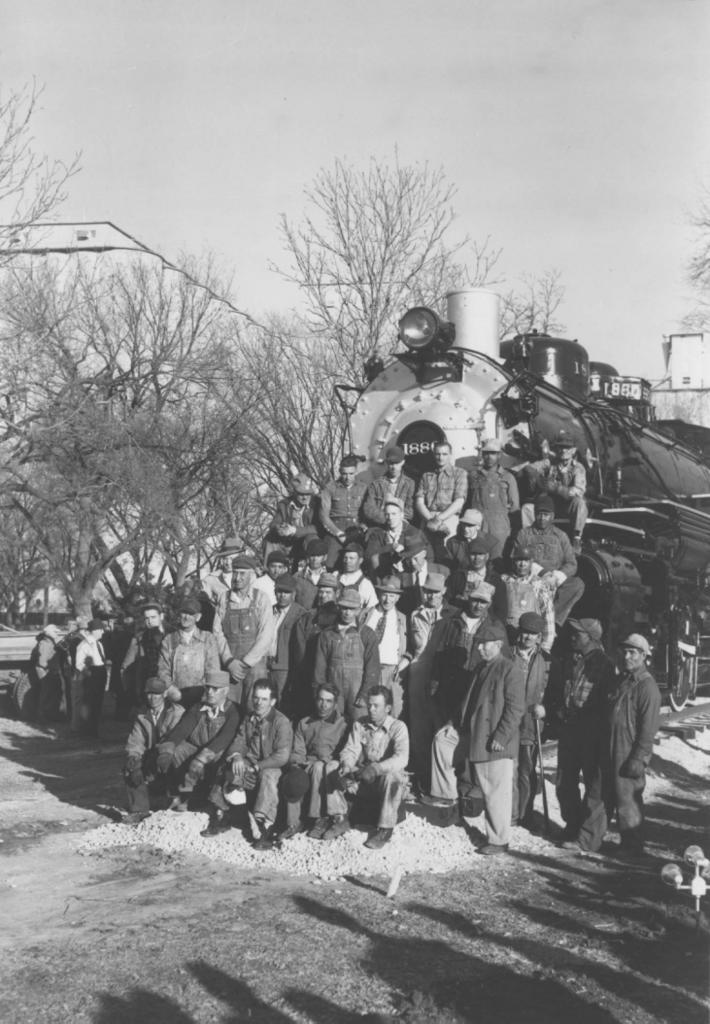
Well, it's over... this huge event we planned and stage in Newton, Kansas. Last Saturday, we read the names of about 50 men who helped move Santa Fe Engine 1880, a Prairie-type steam locomotive, into Military Park.

The older guys were surprised we had such a large turnout. I can't say I was surprised, but I was especially pleased. For months I'd worked to track down these men, their wives and kids, in hopes of finding people to invite. Turns out only about six of the original movers survive. We did pull in about three of them into the event, along with wives and children and grandchildren and great-grandchildren.

The best thing to come out of it? I can say all the hard work was worth the looks on the faces of kids standing in front of the engine with proud looks on their faces, waiting to have a photo taken. We've reached yet another generation. They've bought into it all... Newton railroading history, Engine 1880... assuring a loyal group who has emotional ties now, and no longer will think of the engine as a heap of black metal in the park.

Gotta love it.